Crate Keepers: The Record Shop Owners Who Became Guardians of America's Forgotten Sound
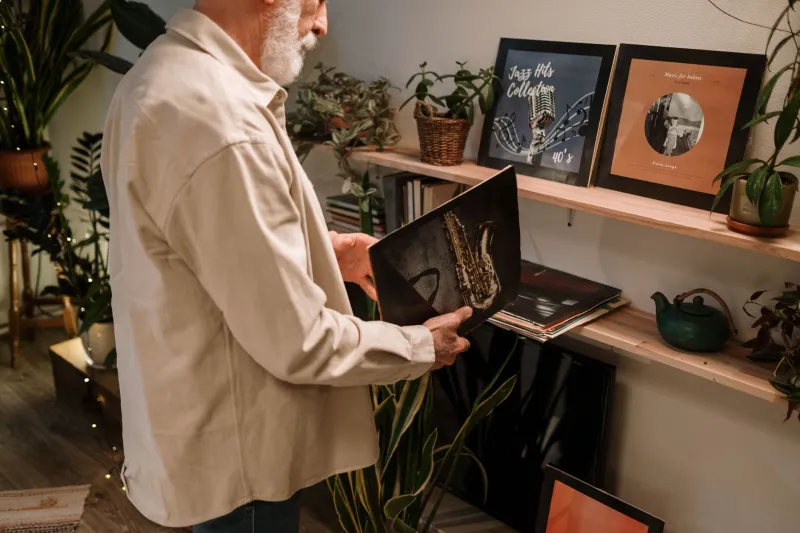
Walk into Delmar's Sound Exchange in East St. Louis on a Saturday morning and you'll probably spend the first ten minutes just standing there. Not because the selection is overwhelming — though it is — but because the walls are talking. Handwritten index cards tacked next to album covers. Faded concert flyers framed above the bins. A photograph of a woman nobody outside of a fifty-mile radius would recognize, with a caption that reads: "Loretta Simms. Played every juke joint on the Illinois side. Never recorded a studio album. This is the only photo anyone knows of."
That's not a museum exhibit. That's just Tuesday at a record shop.
More Than Merchandise
The independent record store has been declared dead roughly a dozen times since the late nineties. Streaming killed it. Downloads killed it. Big-box retail killed it. And yet, here these places are — not just surviving, but quietly transforming into something nobody quite planned for.
What's happening inside the best of these shops goes way beyond commerce. Owners and longtime collectors have started functioning as de facto oral historians, piecing together the human stories behind recordings that never got a press release, a Rolling Stone profile, or a Wikipedia entry. Regional blues artists. Local gospel choirs who pressed a hundred copies of a 45 and sold them out of church basements. Tejano bands from small Texas towns whose only documentation is a cracked sleeve and someone's fading memory.
"The music is the artifact," says Marcus Tillman, who has run a shop called Heavy Rotation in Memphis for going on nineteen years. "But the story is what keeps it alive. Anybody can digitize a record. Not everybody can tell you that the guy who played rhythm guitar on track four was also the guy who taught half the neighborhood kids how to read music for free."
Tillman keeps a composition notebook behind the counter. Every time a customer comes in with a piece of information he didn't have — a name, a venue, a year, a family connection — he writes it down. He's filled eleven of them.
The Geography of Sound
One of the things that makes this kind of preservation so urgent is how deeply regional American music actually is. Mainstream music history tends to flatten everything into a handful of cities and a handful of names. But the real map is a lot messier and a lot richer.
There's a shop in Albuquerque called Arroyo Records where the owner, a woman named Connie Baca, has spent years building what she calls a "sound geography" of New Mexico's musical past. She's got sections dedicated to artists from specific valleys, specific pueblos, specific neighborhoods. She cross-references albums with the communities they came from, and she's started hosting monthly listening sessions where elders come in and fill in the blanks.
"Google can tell you a release date," Connie says. "It can't tell you that this album was recorded in someone's living room because the nearest studio was four hours away and nobody could afford the gas. That context changes everything about how you hear the music."
Those listening sessions have become something genuinely rare: a space where a seventy-eight-year-old and a twenty-two-year-old are both learning something new at the same time, and both have something to contribute.
Intergenerational Static
That kind of cross-generational exchange is part of what makes these shops different from other preservation efforts. Archives are great, but they can feel inaccessible — temperature-controlled rooms, appointment-only access, the quiet intimidation of institutional spaces. A record shop is just a room with music in it. Anyone can walk in.
In Baltimore, a shop called Wavelength has made that openness into something intentional. The owner, Devon Park, started a program two years ago where high school students come in once a month to interview older collectors on camera. The videos go up on a community YouTube channel. They're not slick productions. They're two people sitting on folding chairs in front of a wall of vinyl, talking about what music meant to them and why.
The most-watched video on the channel features an eighty-one-year-old man named Earl talking for forty minutes about a local funk band called the Eastside Arrows, who broke up in 1974 and whose music Devon had never been able to find a single copy of anywhere.
Three weeks after the video went up, someone mailed Devon a box of records. Inside was a hand-labeled acetate of the Eastside Arrows' only recording session.
"That's the whole thing right there," Devon says. "You put the story out into the world and the world sends the story back."
What Gets Lost When These Places Close
For every shop that's thriving, there are several that didn't make it. And when they close, what disappears isn't just a retail space — it's a repository. Those composition notebooks. Those index cards. Those conversations that happened a thousand times over the counter and never got written down anywhere.
There's a growing movement among independent shop owners to formalize what they've been doing informally for decades. Some are partnering with local libraries. Some are digitizing their documentation and uploading it to community-run archives. A loose national network called the Regional Sound Collective has started hosting annual gatherings where shop owners share preservation strategies and connect with music historians and ethnomusicologists who can help them think through what they've got.
But a lot of the work is still happening one conversation at a time, one handwritten card at a time, in stores that smell like old cardboard and coffee and whatever the owner decided to put on the turntable that morning.
The Record as a Door
Maybe the most powerful thing about a record shop as a preservation space is that the music itself does the heavy lifting. You don't have to already care about regional history to walk in. You just have to hear something that makes you stop and ask: Who made this?
That question — simple, instinctive, human — is where community memory starts. The crate keepers are just the ones making sure there's someone there to answer it.
And to write the answer down before the person who knows it is gone.