Thread by Thread: The Quilting Circles Piecing America's Untold Stories Back Together
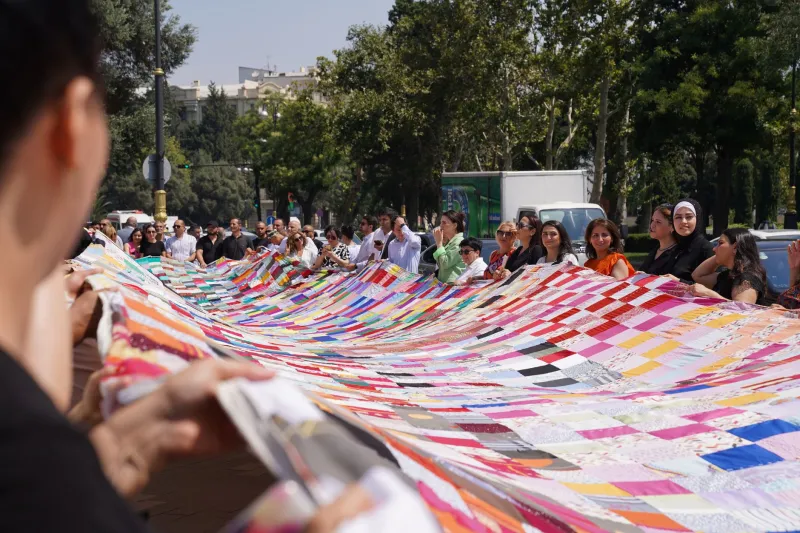
Somewhere in a church basement in Greensboro, North Carolina, eight people are hunched over a wooden frame the size of a dining room table, arguing — gently, lovingly — about whether a particular shade of indigo is close enough to the color of the sky on the night the Woolworth's sit-in happened in 1960. This is the Piedmont Story Quilt Collective, and they've been meeting every other Saturday for three years. What they're building isn't just a blanket. It's a document.
Across the country, community quilting circles are having a moment. And the timing isn't accidental.
More Than a Hobby Resurgence
Yes, craft culture broadly has seen a pandemic-era bump that never quite went away. Knitting, ceramics, bookbinding — people rediscovered the pleasure of making things with their hands when the world locked down, and many of them never stopped. But the quilting revival happening in neighborhood spaces feels like something with more specific intention behind it.
These groups aren't just gathering to relax. They're gathering to remember. And to make sure other people remember too.
In Chicago's Pilsen neighborhood, a predominantly Mexican-American community that's been navigating the pressures of gentrification for over a decade, the Pilsen Patch Project has spent the last two years creating a series of collaborative quilts that map the neighborhood block by block. Each square was designed by a different family — some of them third-generation residents, some of them recent arrivals — and depicts something specific: a storefront that closed, a mural that got painted over, a grandmother's garden, a quinceañera dress.
"We kept hearing people say the neighborhood was changing so fast they couldn't keep up," says Marisol Ybarra, one of the project's co-founders. "The quilt doesn't stop that. But it means there's a record. It means someone looked at this block and said, 'This mattered. These people were here.'".
Old Craft, New Stakes
Quilting in America has always carried social weight that outsiders sometimes miss. Enslaved people in the antebellum South are believed by many historians to have encoded information into quilt patterns hung on fences and clotheslines — a visual language for people who were legally forbidden from written literacy. During the Great Depression, quilts made from feed sacks and worn-out clothing were both practical survival tools and intimate family archives. The AIDS Memorial Quilt, launched in 1987, turned the medium into one of the most powerful acts of collective mourning in American history.
So when people say quilting is having a revival, it's worth asking: a revival of what, exactly? The craft itself never went anywhere. What's being revived might be the understanding of quilting as community infrastructure — as a reason to gather, a framework for sharing, and a format for preserving what might otherwise be lost.
Rev. Constance Delray, who facilitates a quilting circle at her AME church in Memphis, puts it plainly. "Black women in this country have been quilting their history for centuries because nobody else was going to write it down for them. What I see now is more people — all kinds of people — figuring out that this is actually a really powerful tool. And I think that's beautiful."
Who's Showing Up
One of the most striking things about the current wave of community quilting circles is who's in the room. These aren't exclusively women, and they're not exclusively older. Groups across the country report a genuine mix of ages, genders, and backgrounds — sometimes united by geography, sometimes by shared heritage, sometimes just by a flyer someone posted at the library.
In Portland, Oregon, a circle called Stitch & Story was started by a Somali-American woman named Hodan Warsame, who wanted a space where refugee and immigrant women could share textile traditions from their home countries while learning American quilting techniques. What's emerged is something genuinely hybrid — quilts that combine Somali suuf embroidery patterns with traditional American log cabin blocks, Vietnamese patchwork aesthetics with Appalachian color palettes.
"Every woman who comes brings her hands and her history," Warsame says. "The quilt ends up being all of us."
Men are showing up too, often with a sheepishness that tends to dissolve pretty quickly once they're actually sitting at the frame. Marcus Webb, a 34-year-old electrician in Detroit, joined a community quilting project focused on documenting the history of Black-owned businesses in his neighborhood after his uncle's barbershop closed. "I didn't know how to sew at all. I still don't, really," he laughs. "But I knew my uncle's story, and I knew how to tell it. Someone else figured out how to put it in fabric."
The Quilt as Archive
What makes community quilts particularly interesting as a form of grassroots documentation is their physical permanence and their legibility. Unlike a digital archive that requires software and internet access, or an oral history recording that demands someone sit down and press play, a quilt exists in space. It can hang on a wall at a community center or a library. Kids can look at it. Visitors can ask questions about it. It invites conversation in a way that a database simply doesn't.
Several groups have begun working with local historical societies and libraries to ensure their quilts are formally accessioned as community artifacts. The Greensboro collective has already donated one completed quilt to the city's African American Cultural Center, where it hangs near photographs from the civil rights era.
"We wanted it to be somewhere people could actually see it," says Della Thornton, one of the collective's founding members. "Not in someone's attic. Not rolled up in a closet. Out in the world, where it can keep doing its job."
Slow Craft, Real Connection
There's something else worth naming about what happens in these circles, beyond the quilts themselves. Quilting is slow. It requires sustained attention and repeated, rhythmic movement that has a way of loosening people up. Conversations that might feel forced in a focus group or a town hall meeting tend to unspool naturally when your hands are busy and nobody has to make eye contact if they don't want to.
People share things in quilting circles that they might not share anywhere else. Family secrets. Immigration stories. Grief. Pride. The kind of texture that never makes it into the official record.
"We've had people cry," says Ybarra. "We've had people laugh until they couldn't breathe. We've had people share things about their families that their own kids didn't know. That's the magic of it. The quilt gives you something to do with your hands so your mouth can just go."
In a cultural moment that often feels fragmented and loud, there's something quietly radical about a group of people sitting down together to make something that will outlast all of them — something stitched through with the specific, irreplaceable details of lives actually lived.
Thread by thread. Square by square. Story by story.
The circles are open, and there's always room at the frame.