Red Light, Real Stories: How the Home Darkroom Became America's Newest Family Archive
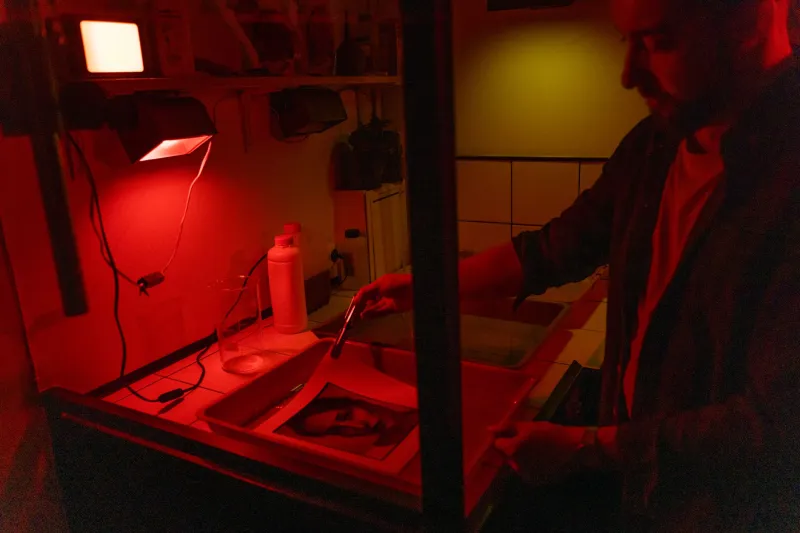
There's something almost ceremonial about it. The lights go out. The red safelight hums on. And then, in a shallow tray of developer solution, a face you've never seen before slowly appears on a blank sheet of paper — a grandmother at nineteen, a grandfather in a uniform, a street corner that no longer exists. For a growing number of Americans, this is not a darkroom class or a nostalgic hobby. It's an act of excavation.
The home darkroom is back. And it's bringing a whole lot of history with it.
From Forgotten Rolls to Found Families
Spend any time in analog photography communities online — subreddits, Facebook groups, Discord servers with names like Film Is Not Dead — and you'll start to notice a pattern. Mixed in among the posts about expired Kodak Tri-X and vintage Pentax cameras are stories that feel less like hobby updates and more like personal revelations.
A woman in Cleveland finds three rolls of undeveloped 35mm film tucked inside her late mother's sewing box. She learns to develop black-and-white film in her bathroom, and the negatives yield images from the 1970s — her mother as a teenager, laughing in front of a house that burned down years ago. A man in rural Georgia inherits a box of his grandfather's slides and buys a used enlarger off Craigslist to print them himself. He ends up with portraits of Black sharecroppers in the 1950s that no one in his family had ever seen.
These aren't isolated moments. They're part of a quiet, grassroots movement that sits at the intersection of the analog photography revival and a broader cultural hunger for connection to the past.
Why Analog, Why Now
Digital photography is extraordinary at capturing everything. It's less good at making you care about any of it. We take thousands of photos a year and look at almost none of them. The friction is gone, and with it, so is some of the meaning.
Analog photography reintroduces friction — deliberately, beautifully. You get 24 or 36 frames on a roll. You can't see what you've captured until you develop it. And if you're printing in a home darkroom, you're spending real time with each image: exposing it under the enlarger, watching it emerge in the developer, deciding when it's right. That slowness changes something in how people relate to photographs.
"When I finally printed my great-aunt's portrait from a negative she'd shot in 1963, I stood in that darkroom for probably ten minutes just looking at it," says one hobbyist from Portland who documents her family history through analog printing. "You can't do that with a JPEG on your phone. The physicality of it makes it feel real in a way that's hard to explain."
Community educators and archivists have started paying attention. Some public libraries and community centers are quietly reintroducing darkroom programming — not just as an art class, but as a tool for community memory work. Organizations focused on oral history and cultural preservation are pairing film photography workshops with storytelling sessions, recognizing that the darkroom can be a surprisingly powerful space for intergenerational conversation.
The Gear Is More Accessible Than You Think
Part of what's fueling this revival is economics — counterintuitively, in the right direction. As digital photography ate the consumer market, enormous quantities of analog equipment flooded the secondhand market. Enlargers, developing tanks, chemical trays, and even full darkroom setups have been available on eBay, at estate sales, and in thrift stores for years, often for less than a decent dinner out.
A functional home darkroom can be set up in a bathroom for under $150 if you're patient and resourceful. The chemicals are cheap. The film, while pricier than it used to be, is still widely available. And the learning curve, while real, is navigable — especially with the explosion of YouTube tutorials, community forums, and in-person film photography clubs that have sprouted up in cities and small towns alike.
This accessibility matters. It means the darkroom isn't just for art school graduates or well-funded hobbyists. It's for the retired postal worker in Albuquerque who found a box of her father's negatives. It's for the high school junior in Detroit who wants to document his neighborhood before it changes. It's for anyone who has ever looked at an old photograph and wished they understood more about the person in it.
The Darkroom as Conversation Starter
What strikes people who've gone deep into this world is how often the darkroom becomes a catalyst for conversations that wouldn't have happened otherwise. There's something about handing a grandparent a freshly made print of their own past that opens doors.
Families report sitting down together to look at contact sheets and ending up in hours-long conversations about migration, loss, joy, and survival. Kids who would never sit still for a family history lecture are suddenly fascinated when they watch a photograph develop in a tray in real time. The process itself becomes a shared language.
This is exactly the kind of cultural work that community organizations focused on identity and memory have been trying to figure out how to support. The darkroom, it turns out, doesn't need much scaffolding. It does a lot of the work on its own.
More Than Nostalgia
It would be easy to dismiss all of this as a retro trend — another case of younger generations fetishizing the analog past. But that reading misses something important. For a lot of people, this isn't about rejecting the present. It's about recovering something that got lost in the rush toward it.
Family photographs have always been one of the primary ways communities transmit identity across generations. They are evidence of existence. They say: we were here, we looked like this, this is what mattered to us. When those images are locked inside undeveloped rolls of film or deteriorating slides in someone's attic, that transmission gets interrupted.
The home darkroom revival is, in its own hands-in-the-chemicals way, an act of repair. People are learning a craft specifically so they can recover images that would otherwise be lost — images that belong not just to their families but to the broader story of American life.
The red light comes on. The developer swirls in the tray. And somewhere in that chemical bath, a story that almost disappeared is finding its way back to the surface.
If you've got undeveloped film sitting in a drawer somewhere, now might be the time to find out what's on it.